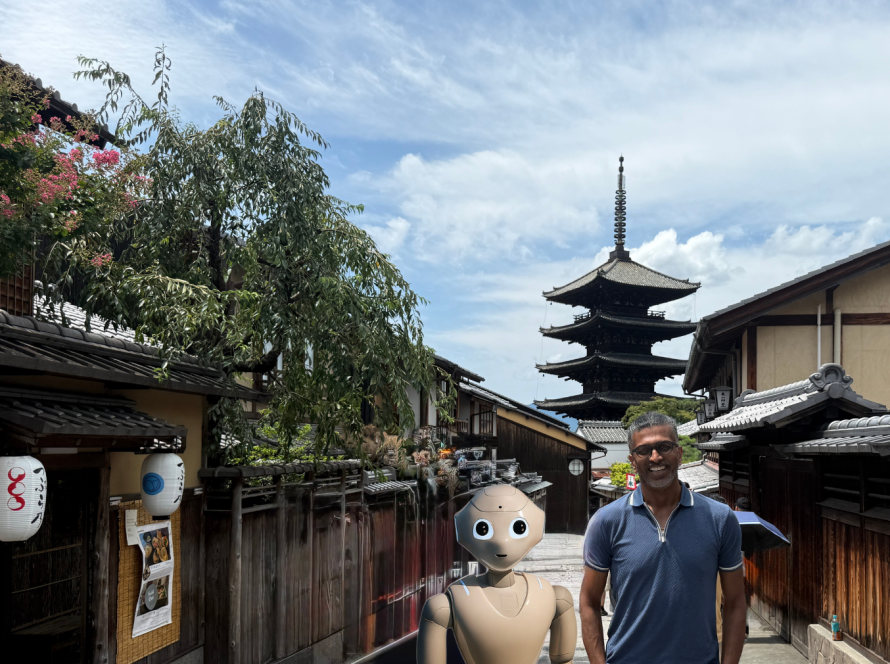
Each year, I joke that I’m celebrating the anniversary of my 25th birthday. On Tuesday, it was the 28th anniversary — and I chose to mark it on the Great Wall of China.
The wind was colder than I had dressed for. It came rushing over the mountains and across the exposed stone, slipping through the layers I had convinced myself would be enough. Up there, you feel how exposed the wall is.
The stone beneath my feet was uneven and slick with patches of ice and snow, worn smooth by centuries of footsteps long before mine. The wall stretched farther than my eyes could follow, bending into mountains that seemed to hold more memory than history books ever could.
It was a strange place to feel both small and sharply aware of your own passing time.
There I was — another human, another birthday — standing on something built by people who must have believed their moment in history was just as urgent, just as uncertain, as ours feels now.
Empires have risen and fallen since those stones were first laid. Wars have come and gone. Borders have shifted. Leaders have declared permanence and then disappeared into footnotes.
From that height, the present felt both loud and very far away.
As I stood there, the headlines were anything but calm. Israel. Iran. Escalation across the Middle East. Statements, strikes, speculation. The world feeling combustible in ways that are both familiar and new.
And somewhere between that height and those headlines, questions I had asked my colleagues days earlier returned.
Last week, standing in Hong Kong and looking out over the harbor — the skyline clouded in fog, boats moving quietly across dark water — I turned to a couple of my colleagues and asked something I don’t often ask out loud.
“Does this all feel pointless? Is it worth it?”
I was talking about the work we do. The building. The planning. The strategy. The hours spent thinking about the future of students and institutions and opportunity.
In that moment, watching the harbor, the scale of the world felt overwhelming. Conflicts were escalating. Headlines were flashing. Markets were reacting. Leaders were posturing.
And our work — meaningful on most days — suddenly felt small against the scale of it all.
The silence that followed told me I wasn’t alone.
Standing on the Great Wall days later, those questions followed me.
What is the point of building anything when the world feels like it’s burning?
It felt strange to be wondering whether building still mattered while beneath my feet stretched a structure built to defend an entire civilization.
And then I realized something.
The world has always felt like it was burning to someone.
Every generation has its moment of existential fear. Every era believes its instability is unprecedented. Every news cycle convinces us we are standing at the edge of something irreversible.
And yet humanity keeps building.
The Great Wall was not constructed in a season of comfort. It rose through uncertainty, through threat, through instability. It exists because people believed what they were protecting was worth the effort.
That perspective does not trivialize current suffering. The conflicts unfolding today are real. Lives are disrupted. Families are afraid. The stakes are human and immediate.
But there is a difference between acknowledging danger and surrendering to despair.
And if we are honest, despair has become strangely accessible.
Modern conflict does not sit at a distance. It streams directly into our nervous systems. Every notification, every urgent headline, every looping video keeps us activated. We scroll because we care. We scroll because we want to understand. But somewhere between caring and consuming, we get depleted.
Previous generations lived through war, upheaval, and uncertainty too. The difference is that they experienced it locally.
We experience it everywhere, all the time.
We begin to mistake constant reaction for moral engagement. Attention has become our substitute for action. We confuse outrage with impact. And when that emotional surge lingers long enough, it turns into something heavier — quiet hopelessness.
There is a temptation in moments like this to declare everything broken. To perform despair as proof that we are paying attention. It feels sophisticated. It feels morally awake.
But despair can become a form of surrender dressed up as depth. It releases us from the harder discipline of continuing.
When I asked in Hong Kong whether any of this was worth it, what I was really expressing was fatigue. Not with the work itself, but with the weight of the world pressing against it.
We like to imagine that meaningful work is driven by clarity. That the people who shaped the future were certain about what they were doing.
But history rarely works that way.
Most people who built the systems we rely on today were improvising their way through uncertainty.
They worried.
They doubted.
They wondered whether any of it mattered.
And they kept going anyway.
Uncertainty has never been a sign that the work doesn’t matter. It has always been the condition under which meaningful work happens.
I now understand something I did not when I was younger.
You do not build only in peaceful times.
You build precisely because times are uncertain.
The people who laid those stones did not know how history would judge their work. They did not know whether the wall would succeed.
Whether it would hold.
Whether it would even matter.
Most of them would never see the finished structure.
They were not building monuments to certainty. They were contributing small pieces to something larger than their own moment.
Civilizations are actually built by people who never get to see the outcome.
Teachers who never meet the leaders their students become.
Researchers whose discoveries matter decades later.
Parents who raise children they will never fully understand as adults.
Builders who lay foundations they will never stand upon.
Most meaningful work is invisible at the time it is done. And that invisibility can make it feel pointless.
But history is full of structures that only exist because enough people continued working when the future was unclear.
The opposite is also true.
Societies rarely collapse because of a single crisis. They collapse when enough people quietly stop believing their effort matters.
When builders become spectators.
When participation turns into commentary.
If history teaches anything, it is that panic rarely produces clarity. Steadiness does.
Standing still does not mean ignoring the fire. It means refusing to let the flames dictate your posture. It means continuing to contribute where you stand.
Students still need guidance.
Young professionals still need opportunity.
Families still need hope.
Communities still need builders.
The world does not stabilize because everyone pauses. It stabilizes because enough people decide to remain steady.
At 53, I feel tension differently than I did at 25. I no longer believe stability is the absence of conflict. Stability is the discipline of continuing in its presence.
The headlines will flare. They always do.
What we choose in response defines us.
We can amplify fear, scroll endlessly, perform outrage, and let anxiety shape our days.
Or we can acknowledge reality, feel its weight, and then return — deliberately — to our work.
Standing on that wall, I did not feel invincible. I felt small. Temporary. Human.
But I also felt something else.
Perspective.
Empires fall. Conflicts erupt. Technologies disrupt. Markets swing.
Human beings endure.
You do not have to solve the world to serve it.
You do not have to extinguish every fire to stand steady in your own life.
Most of us are not responsible for geopolitical escalation. We are responsible for how we show up — at home, at work, in our communities.
When the world is loud, our steadiness becomes leadership.
When tension rises, our restraint becomes strength.
When despair tempts us to disengage, our refusal to collapse becomes example.
The world may feel like it is burning.
Stand still anyway.
Not in denial.
Not in indifference.
In posture.
Guard your center.
Because in volatile times, posture is power.
And the future still belongs to the people who keep building.
Ex Cogitatione, Progressus
Girish