Over the past few months, I’ve been trying to understand why the world feels heavier than it used to.
Not necessarily more dangerous. Human history has survived darker chapters than the one we happen to be living through. Not more uncertain. Every generation eventually discovers that certainty was always an illusion. And certainly not more divided. We have been arguing about politics, religion, borders, identity, and belonging for as long as people have gathered into societies.
Yet something feels different.
The headlines change every day, but the feeling doesn’t.
It took me a while to realize that I wasn’t reacting to any single event. It wasn’t one war, one election, one immigration policy, one technological breakthrough, or one cultural battle. It was something subtler than that, something sitting beneath all of them. More and more, I find myself wondering whether we have begun organizing our lives around the assumption that suspicion is wisdom—and whether we have stopped noticing how expensive that assumption has become.
Every morning begins with small rituals of verification. My phone asks me to prove that I am who I say I am. My bank needs a security code whenever I want to use my own money. Websites authenticate my identity before allowing me to continue. Unknown phone numbers are ignored because they are probably scams. Emails from unfamiliar addresses are opened carefully, if at all. Artificial intelligence now forces us to question photographs, voices, videos, and even the evidence of our own eyes.
None of these precautions are unreasonable. Fraud exists. Cybercrime exists. Human trafficking exists. Corruption exists. There are people who exploit systems, institutions that betray trust, governments that abuse power, and individuals who prey on generosity. History has earned our skepticism.
But somewhere along the way, I think we crossed a line.
The more I reflect on it, the more convinced I’ve become that scrutiny and suspicion are not the same thing, even though we increasingly behave as though they are. Scrutiny asks difficult questions because it genuinely wants truthful answers. Suspicion often begins with an answer and simply waits for enough evidence to justify it. One remains open to discovery. The other has already decided what it expects to find. That distinction may sound philosophical, but I suspect it changes far more than our opinions. It changes the atmosphere in which a society lives.
I keep thinking about a phrase I heard much more often growing up than I do today: the benefit of the doubt.
It was never presented as blind trust or naïveté. It was simply a recognition that most human beings deserved to be understood before they were judged. It reflected a kind of belief that we could investigate honestly without immediately assuming the worst. Somewhere along the way that instinct seems to have weakened. Today we are encouraged to identify motives before actions, agendas before words, deception before sincerity. Every disagreement risks becoming evidence of hidden intent. Every mistake becomes a character flaw. We have become remarkably good at protecting ourselves from being fooled. I sometimes wonder whether we have become equally good at overlooking one another’s humanity.
In my own life, I have learned that even love can become suspect when trust begins to disappear.
Life has a way of teaching lessons you never expected to learn. One of mine has been discovering how quickly ordinary acts can require explanation once trust begins to erode. Simply wanting to be a parent, show up, to care, to be present, can suddenly feel as though it needs justification. The details are deeply personal, but the lesson itself is universal. When suspicion enters a relationship, it doesn’t merely change how we interpret another person’s actions. It changes the atmosphere in which those actions exist. Before long, it changes us.
The tragedy of suspicion is not that it expects the worst from others. It is that, over time, it teaches us to build a world that expects the worst from everyone.
I’ve watched this change unfold in international education over the course of my career. The conversation used to begin with possibility. Increasingly, it begins with risk. We measure international students by the dollars they contribute, the compliance they require, the visas they hold, or the regulations they might violate. Those concerns matter, but I’ve started wondering what happens when they become the first lens through which we see another human being.
Over the past few years, conversations about international students have become increasingly framed through the language of enforcement, compliance, national security, fraud prevention, and institutional risk. Some of those concerns are legitimate. Every system has people who exploit it. Every government has an obligation to protect its borders. Every university has a responsibility to uphold academic standards. None of that strikes me as controversial.
What I’ve found myself wondering instead is what happens when accountability slowly gives way to presumption. There is an enormous difference between asking someone to meet a standard and asking them to prove they deserve to be trusted before they have done anything to lose that trust. The policies can look remarkably similar on paper while creating entirely different experiences for the people living under them.
An international student who feels welcomed carries themselves differently from one who feels perpetually examined. An employee who feels trusted contributes differently from one who feels constantly monitored. A citizen who believes institutions are fundamentally fair participates differently from one who assumes every institution is hiding something.
The rules matter.
But the assumptions underneath the rules matter just as much.
I’ve started wondering whether systems are far less objective than we imagine. Over time they begin to resemble the assumptions that created them. If we assume students are naturally curious, we tend to build schools that encourage curiosity. If we assume employees want to contribute, we create organizations that allow responsibility to grow. If we assume deception is everywhere, we eventually create institutions that spend more energy protecting themselves than serving the people they were created to serve.
Systems have a way of becoming mirrors. Eventually, they reflect back the beliefs that shaped them.
Perhaps that is why I keep coming back to the idea of invisible infrastructure.
We usually think of infrastructure as something physical. Roads. Airports. Bridges. Universities. Courthouses. But the most important infrastructure in any civilization cannot be photographed. It exists in the assumptions that allow millions of strangers to cooperate every day without ever meeting one another.
The assumption that contracts will usually be honored.
That teachers are trying to educate rather than indoctrinate.
That scientists are honestly pursuing truth.
That judges are attempting to apply the law fairly.
That journalists are making a sincere effort to report faithfully.
That parents generally love their children.
None of those assumptions have ever been universally true. Human beings have always lied, cheated, manipulated, and disappointed one another. Civilizations have never depended on perfect people. They have depended on enough people acting in good faith often enough that cooperation remains possible.
The more I think about it, the less convinced I am that societies survive because everyone trusts one another. That has never been the case. They survive because enough people begin with the possibility that others are acting in good faith. That possibility is fragile. It is tested constantly. Sometimes it is betrayed. Yet without it, cooperation becomes exhausting because every interaction begins as a negotiation rather than the beginning of a relationship.
I don’t know if that idea has become more important to me because of age, because of experience, or because of the particular moment we happen to be living through.
What I do know is that I have become increasingly fascinated by what happens when intelligent societies slowly lose the habits that made their intelligence useful in the first place. Knowledge continues to accumulate. Technology continues to improve. Institutions become more sophisticated. Yet wisdom can still move in the opposite direction. Fear begins replacing judgment. Certainty replaces curiosity. We become better informed and less interested in understanding one another.
I’ve spent the better part of the last few years exploring that question far more deeply than I ever expected to. At some point, I realized I wasn’t simply collecting notes anymore. Those notes had become the beginning of my recent book. The more I have read, written, and reflected, the more convinced I have become that stupidity rarely announces itself as ignorance. More often, it arrives dressed as certainty. It is remarkably comfortable with simple explanations for complicated people and permanent conclusions drawn from incomplete evidence.
Years ago, when I arrived in America as an international student, what captivated me most was not its certainty. America has never been certain. It was its confidence. Confidence that ideas mattered. Confidence that talent could come from anywhere. Confidence that someone born halfway around the world could contribute meaningfully to the country’s future.
That confidence has always existed alongside fear.
Every nation wrestles with that tension. Every institution does. Every family does. Every one of us does.
One path asks, “What might we build together?”
The other asks, “What must we protect ourselves from?”
Perhaps those questions have always existed. The difference today is that the second one seems to be winning more often than I remember.
Maybe that is the feeling that has weighed heavily on me these past few months.
Not that the world has suddenly become darker.
Not that people have suddenly become worse.
But that we are renegotiating the assumptions we make about one another.
If those assumptions continue to drift toward permanent suspicion, our institutions will eventually reflect that choice back to us. Our schools will feel different. Our workplaces will feel different. Our politics will feel different. Our relationships will feel different. Not because the rules changed first, but because the stories we began telling ourselves about other people changed first.
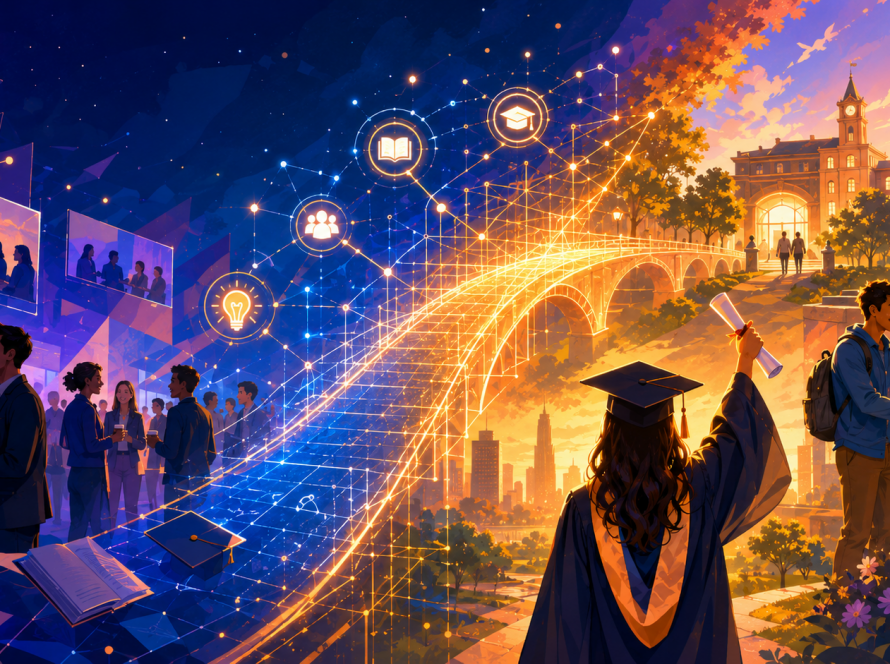
Civilizations are built long before the first road is paved or the first building rises into the skyline. They are built in the assumptions people make about one another. Long before steel is poured into a bridge, someone has already decided that the people on the other side are worth reaching.
I hope we don’t lose that instinct.
Once we do, rebuilding trust becomes infinitely harder than building walls.
Roads can always be repaved. Bridges can always be rebuilt. Institutions can be reformed. Laws can be rewritten. But it is far more difficult to persuade a society to believe in one another again.
Maybe that is the work in front of us.
Not becoming less skeptical. But becoming more deliberate about where skepticism ends and suspicion begins.
Civilization has always depended on people who were willing to begin there.
Ex Cogitatione, Progressus
Girish