SNAP!
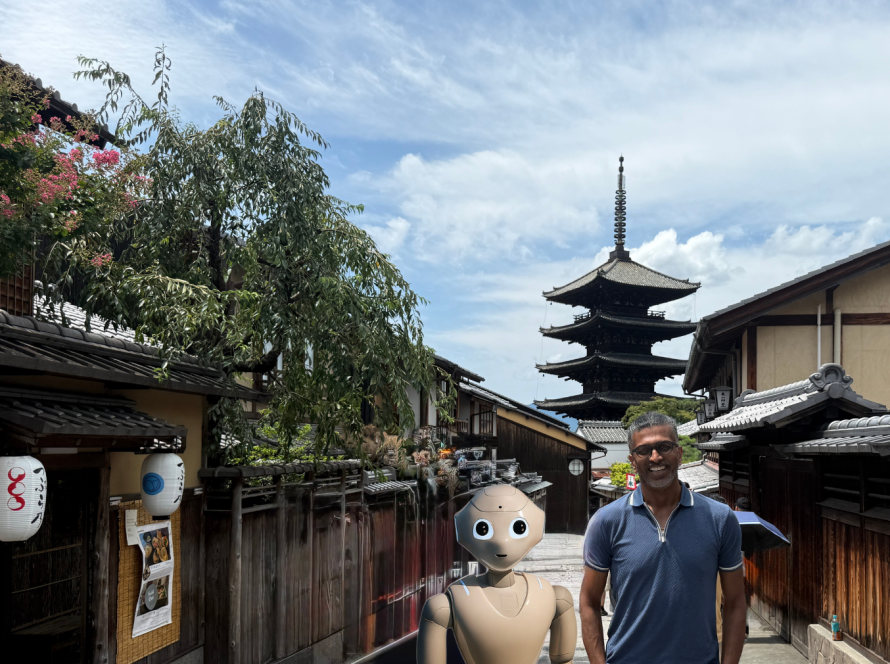
Arms lift. Phones tilt toward skylines, temples, street corners. A moment is captured before it has even been fully experienced.
Proof we were there.
You don’t actually hear the sound anymore. Most phone cameras are silent now.
But the reflex is everywhere.
Over the past eight months, I have moved through four continents and eighteen countries. Airports, taxis, colorful currencies, new languages, unfamiliar rhythms of daily life. When I say it out loud it sounds almost glamorous, the sort of line people casually offer to signal that they have seen something of the world.
But somewhere along the way, amid the flights and conference halls and wandering afternoons in cities whose names I had only known from maps and books, I began to notice something about the way we move through the world now. Something that made me slightly uneasy about my own habits.
We arrive in extraordinary places and within seconds our phones are in our hands.
A temple older than the country we live in. A market alive with languages we cannot understand. A street that has carried generations of footsteps before ours ever appeared. And yet the instinct is immediate, almost unconscious. Before curiosity has a chance to breathe, we lift our phones.
I catch myself doing it all the time. Walking into a place layered with centuries of memory and reaching for my phone before I reach for my senses. Sometimes I notice it happening mid-motion, my hand halfway to my pocket, and I stop myself. I put the phone away deliberately and try to do something that feels almost radical now.
I stand still.
I watch.
And when I do, the place begins to change. Or perhaps it is I who begin to change.
The street stops being scenery and becomes life. You start to notice the choreography that quietly unfolds everywhere human beings gather. A father walking his daughter through a crowded market with a protective hand on her shoulder. Two colleagues arguing about something trivial over lunch. An elderly couple sitting quietly on a bench, saying almost nothing but clearly saying everything that needs to be said.
In those moments, the place you are visiting stops being a destination and becomes something else entirely: a community of lives unfolding in real time.
And the longer you watch, the more a certain realization begins to settle in.
Not that the world is identical. Anyone who has traveled even a little knows that cultures carry their own histories, their own rhythms, their own ways of organizing daily life. Languages, foods, gestures, architecture, traditions — the differences are fascinating and worth preserving.
But beneath all of that difference runs something far more familiar than we often admit.
The emotional grammar of being human is remarkably consistent everywhere.
People worry about their children. They complain about work. They chase opportunity, celebrate small victories, nurse quiet disappointments. Teenagers laugh at things their parents don’t understand. Friends linger over food longer than they planned to. Elderly people move through public spaces slowly, carrying entire decades of memory with them.
You begin to notice these patterns everywhere.
Beijing.
Doha.
Budapest.
Nairobi.
Delhi.
Different languages. Different histories. But the same basic human story playing out in millions of variations.
And once you notice that, something subtle begins to happen to the stories you carried with you about the world.
I know this because I have arrived in many places carrying those stories myself.
When I landed in China two weeks ago, I realized I had quietly packed something in my mental luggage alongside my passport and clothes. A collection of impressions gathered over years of headlines, commentary, and casual conversation.
Autocratic government. Surveillance. Big brother watching everything.
I told myself this was simply caution. And of course, some degree of caution is always sensible when you arrive somewhere unfamiliar. But beneath that caution was something else as well — a quiet emotional guard. A subtle sense that I should remain alert in a place I had been taught to regard with suspicion.
And then the same thing happened that happens almost everywhere once you allow yourself to observe long enough.
Life unfolded.
People commuting to work with the same morning fatigue you see in any major city. Families gathering around tables late into the evening. Teenagers staring at something on their phones. Vendors hawking keepsakes with the same mixture of patience and theatrics you could find in markets anywhere in the world.
The narrative I had carried into the country did not disappear entirely.
But it became incomplete.
Because the closer you get to people, the harder it becomes to sustain simple stories about them.
Distance allows narratives to remain tidy.
Proximity makes them complicated.
This may be one of the quiet paradoxes of our time.
We live in an era where exposure to other cultures is easier than at any moment in human history. Flights connect continents overnight. Entire civilizations can be glimpsed through the screens we carry in our pockets. Information flows continuously across borders that once took months to cross.
And yet, despite all of this proximity, many societies seem increasingly certain about the differences that separate them.
More suspicious.
More tribal.
More convinced that the people on the other side of the world must be fundamentally different from themselves.
Part of this is structural, of course. Politics has long understood that fear mobilizes people faster than curiosity does. Media ecosystems often amplify the dramatic and the threatening because those stories travel further and generate more attention. Even religion and ideology have found ways to define belonging by drawing sharp boundaries around who is inside and who is outside.
There is money to be made in fear. Power to be gained in maintaining clear enemies. But the deeper truth may be something less comfortable.
Fear spreads not only because someone profits from it.
It spreads because it protects our sense of identity.
Simple stories about other societies allow us to keep our own worldview intact. If the world beyond our borders is fundamentally strange or threatening, then we do not have to question the assumptions we inherited about how life should be organized.
Real encounters with other cultures make that comfort difficult to maintain.
Because once you begin to observe ordinary life closely enough, the idea that entire civilizations can be reduced to a single narrative starts to feel fragile.
Which may explain why so many modern travelers move through the world physically while remaining emotionally guarded.
We travel widely, yet we often interact with places in a strangely transactional way. The questions we carry into new cities are rarely philosophical ones.
Where is the viral restaurant?
Where is the view everyone photographs?
What experience should I take back with me?
We collect places the way people collect souvenirs.
Meals.
Photographs.
Stories to share when we return home.
Rarely do we ask a different question.
What are we leaving behind?
Not trash. Not footprints.
Something less visible but perhaps more important.
Attention.
Respect.
Curiosity.
Humility.
The willingness to acknowledge that the world is larger, older, and more complicated than the stories we brought with us.
When you approach a place that way, the world begins to feel less threatening.
Not because danger disappears. Every society has its tensions, its politics, its risks. But because the lives unfolding around you begin to outweigh the simplified narratives that once dominated your imagination.
You realize that billions of strangers are navigating the same fundamental concerns you are.
Work.
Family.
Hope.
Disappointment.
The quiet effort of building a life that makes sense within the circumstances you’ve inherited.
And once you see that clearly enough times, something inside you should shift.
Exposure to the world should expand your sense of who belongs inside your moral circle. It should make you slower to judge entire societies from a distance. It should make you curious about the histories and struggles that shape other people’s lives.
In short, it should cultivate humility.
Because if my travels have taught me anything, it is that the world is far too vast, too layered, too human to fit neatly inside the boxes we carry with us.
And yet something curious happens after encounter.
The world has expanded, but the stories we tell about it often shrink again.
The old narratives quietly reappear. The same assumptions settle back into place. Entire societies are once again described in single sentences. The complexity of human life dissolves back into the comfortable language of tribes and borders.
And this is not only true of those who cross oceans and continents. It happens even in places where people from different cultures live side by side every day — sharing neighborhoods, classrooms, offices, and public spaces.
Exposure, it turns out, does not automatically produce understanding.
You can live among difference and still refuse to be changed by it.
Which leaves me wrestling with a puzzle I still can’t quite solve.
If direct experience keeps softening our assumptions about other people, why do we rebuild those assumptions the moment we return home?
Why does the humanity we witness up close — the small kindnesses, the familiar rhythms of daily life, the quiet dignity of people simply trying to build a life — fade so quickly once distance returns?
Perhaps because distance is where simple stories survive.
Up close, people are too complicated to hate easily.
Up close, entire cultures cannot be reduced to headlines.
Up close, the differences that once felt enormous begin to shrink beside the ordinary realities of being human.
But distance restores the old narratives. The comfortable ones. The ones that allow us to place entire societies neatly back into the boxes we carried with us.
And so the world keeps offering the same quiet lesson over and over again — in markets and parks, in crowded trains and quiet neighborhoods, in places whose languages we barely understand but whose humanity we recognize instantly.
It is a lesson about scale.
The scale of the world.
The scale of human experience.
And the smallness of the stories we often use to describe both.
That may be the real tragedy of our time.
Not that the world remains unknown to us.
But that we now have unprecedented access to one another and still struggle to expand the boundaries of our imagination.
Because after everything I have seen around the world— across continents, languages, and cultures — one thought refuses to leave me.
It has never been easier to see the world.
And yet it has never been harder for us to truly see each other.
A world this beautiful should have made us better.
Ex Cogitatione, Progressus
Girish