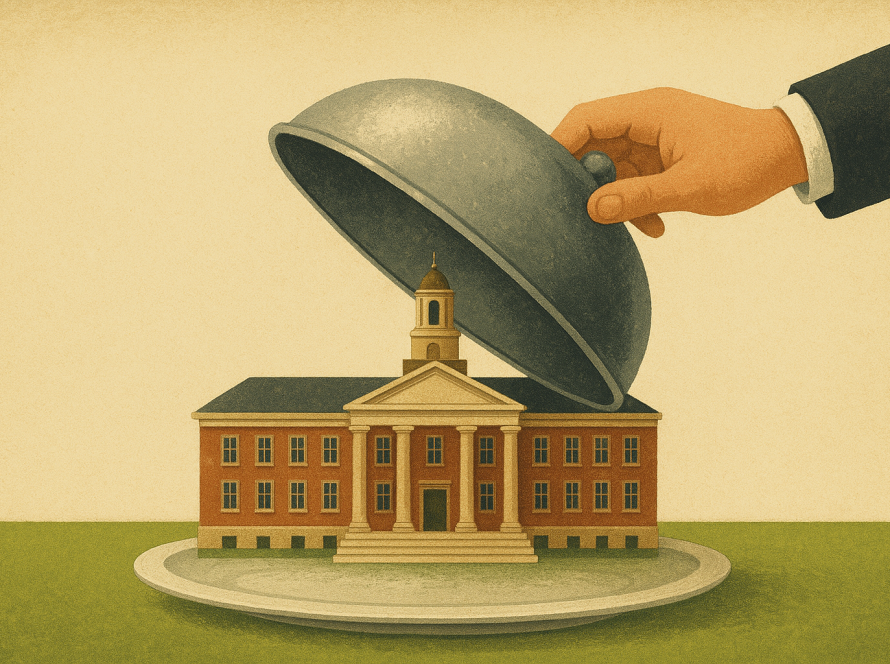
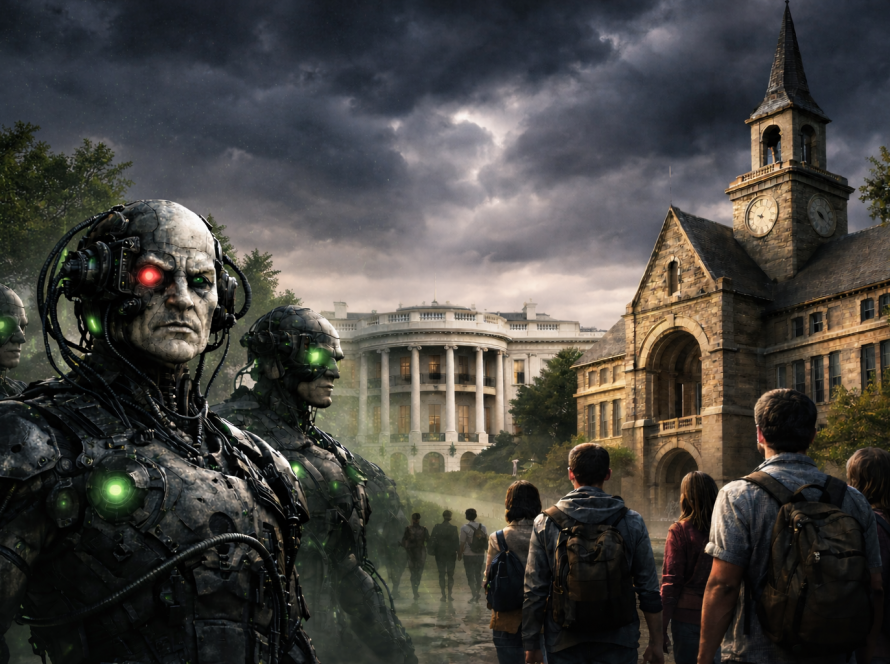
Every new year begins with the same comforting assumption: that what comes next will be a cleaner, calmer extension of what came before.
It won’t be.
The real risk we carry into 2026 isn’t chaos. It’s the belief that stability is about to return on its own. That politics will cool down. That education will catch up. That technology will slow long enough for us to make sense of it. That the world will pause before asking us to choose.
It won’t.
What lies ahead isn’t collapse, but adaptation — uneven, relentless, and demanding. Political power is hardening because fear is easier to govern with than trust. Education systems are fracturing because we keep pretending neutrality is courage. Technology continues to outpace meaning. And students, more perceptive than we give them credit for, are already sensing something most institutions won’t admit out loud: the adults in charge are navigating uncertainty in real time, not following a plan.
This is not the year to ask, What should I do?
It’s the year to ask, How do I orient myself when the rules keep changing?
This edition of My Next Thought isn’t a forecast or a prediction.
It’s an orientation exercise.
Power Is Reorganizing — Long Before the Ballots
When Americans vote in November 2026, most of the decisions will already have been made.
Not at the ballot box — but in the months leading up to it. In classrooms, courtrooms, boardrooms, statehouses, and newsfeeds. In what gets funded. What gets cut. What gets normalized. What gets framed as “risk.”
All 435 seats in the House will be on the line.
A third of the Senate.
Dozens of governorships.
Thousands of state-level offices that quietly shape education policy, immigration enforcement, curriculum, funding, and access.
The election will feel like an event.
But 2026 itself is the campaign.
Globally, the same pattern is unfolding. Power is becoming less apologetic. Borders more transactional. Citizenship more conditional. Democratic norms increasingly procedural rather than participatory.
This matters for education because when political systems strain, schools don’t become sanctuaries. They become instruments. Funding tightens. Narratives harden. Risk aversion replaces curiosity. International mobility becomes leverage.
Students feel this long before institutions admit it.
The question is whether they’ll keep waiting — or start building around systems that won’t catch up in time.
The Economy Will Drift Further from Lived Reality
By every traditional measure, parts of the economy will look “healthy” in 2026. Markets will rally. Productivity charts will rise. Headlines will talk about resilience.
And yet exhaustion will deepen — because people can feel when the math isn’t human.
This will be the year the disconnect becomes impossible to ignore: between growth and wellbeing, between credentials and security, between productivity and purpose.
Students will notice that degrees cost more while promising less. That internships feel symbolic. That stability is offered rhetorically, but withheld structurally. And they will respond not with rebellion, but with recalibration.
They will stop asking, What’s the safest path?
And start asking, What gives me leverage if the system shifts again?
That question will quietly reshape education.
Technology Will Force the Question We’ve Avoided
AI will not “arrive” in 2026.
It will normalize.
It will write, diagnose, design, analyze, translate, and generate at a level that removes any remaining illusion that education’s primary job is information delivery. The threat will no longer be cheating.
It will be redundancy.
The uncomfortable question won’t be whether students can compete with machines. It will be whether institutions are willing to teach what machines cannot replicate — judgment, synthesis, ethical reasoning, contextual intelligence, and the ability to operate without certainty.
Education that avoids this reckoning won’t just feel outdated.
It will feel dishonest — because students can tell when we’re protecting institutions instead of preparing people.
A Necessary Reminder of Scale
We live on a planet orbiting a volatile star, inside a universe that is indifferent to our rankings, elections, and five-year plans.
Solar activity is rising. Climate feedback loops are accelerating. Planetary limits are no longer abstract. These aren’t metaphors — they are boundary conditions we’ve been lucky enough to ignore.
When systems far larger than us remind us of our fragility, the correct response isn’t panic. It’s humility.
And humility is the missing prerequisite in modern education.
Students already sense this. They are less interested in certainty than orientation. Less impressed by authority than by coherence. Less motivated by prestige than by meaning.
What This Means for Education
In 2026, education will quietly split in two.
One path will continue optimizing for compliance, credentials, and signaling to systems that are losing relevance. It will look familiar. It will feel safe. And it will increasingly fail the students it claims to serve.
The other path will be harder to brand but easier to recognize. It will prioritize relevance over reputation. Proof over promises. Capability over coverage. It will allow students to build, test, fail, and adapt in real contexts — not just simulate readiness inside classrooms.
Students won’t announce their choice.
They will simply gravitate toward environments that feel honest — and walk away from those that don’t.
Not because they’re disengaged.
But because they’re awake.
Change Is The Only Constant
But many of the systems we’re waiting on will not change fast enough. Some won’t change at all.
Not because they’re malicious — but because they’re invested in their own survival. Institutions protect continuity before they protect people. That’s not a moral failing. It’s an incentive structure.
But it has consequences.
In 2026, waiting for permission won’t be caution.
It will be abdication.
And pretending otherwise is how smart, well-intentioned people talk themselves into standing still while the ground shifts beneath them.
How to Prepare for a World That Won’t Slow Down
If orientation matters more than certainty, then preparation in 2026 won’t look like control. It will look like capability.
Stop optimizing for stability.
Stability is no longer a destination. It’s a phase — and often a short one. Prepare instead for portability: portable skills, portable identity, portable networks, portable confidence. If your sense of self collapses when one system changes, you’re too dependent on that system.
Build proof, not promises.
The future won’t be impressed by what you intend to do. Build things that exist because you acted. Things that solve real problems. Things that work outside institutional permission structures. Credentials explain. Proof convinces.
Learn to think in systems.
Politics, technology, climate, economics, and education are no longer separate domains. They are interacting forces. Those who thrive will see second- and third-order consequences, ask better questions instead of chasing faster answers, and recognize when a problem is structural rather than personal.
Choose mentors who tell the truth.
Avoid guides who sell certainty. Seek those who admit complexity. In 2026, the most dangerous voices will be the confident ones with simple explanations. The most valuable will be those who help you orient yourself without pretending they control the terrain.
Practice direction, not certainty.
You don’t need a life plan. You need a sense of north. Know what you won’t trade. Know what kind of work gives you energy instead of validation. Know who you build with. Know what systems you refuse to normalize.
Direction compounds.
Certainty shatters.
A New Compact for the Year Ahead
Maps will keep failing.
They always do.
Compasses don’t eliminate fear.
They give you a way to move through it.
I learned that long before I had language for it — 34 years ago next week, stepping into a new country with no guarantees and no safety net.
Some journeys never really end.
They just teach you what you’re no longer afraid of.
Oh, and one last thing as this year begins:
A compass only matters if you’re willing to leave where you are.
Ex Cogitatione, Progressus
Girish